Monday, October 17, 2011

"Doing it Wrong!"

A saying has come to be used in my family to mockingly offer help when someone is having a bit of trouble with a particular task. These tasks are usually mundane, daily tasks that everyone does in his or her own fashion. Coming from a larger family (seven kids, now extended through marriage and the addition of the next generation) trouble with mundane tasks usually comes to light when everyone is gathered for a birthday party or holiday.


For example, when I was trying to cut The Turkey one year with an electric knife, which I had no business doing as I had never wielded the electric knife before, my sister simply, and loudly, let me know I was mucking it up badly by blurting out, "You're doing it Wrooonng!" and everyone around the counter laughed. She then took over and showed me the proper technique to use when working a turkey over with an electric knife. Struggling while trying to cut that cheese for the snack tray? "You're doing it Wrooonng!"
Try to mix your colors and whites in the washing machine with this crew, and you had better believe I'll here it!


Just wait until I get them out in the driveway shoveling snow and chopping ice. They'll be grunting, not using their knees to lift - no sweeping motion with the shovel to use its momentum - wrong angle on the ice chopper, thereby not getting down to the tarmac as our Mother prefers!


"You're doing it Wroooonng!"


As will happen in families, this saying sort of caught on, and has since led to the phrase's use for larger, more significant situations. Perhaps putting money into a car that should be put out of its misery, or trying to grill-out on a freezing New Year's day vs. simply staying inside and watching football like people are supposed to do. "No, you're doing it wrong."


My wife, Denise, and I have found ourselves using the phrase at home while "helping" each other through the day's chores over the years - usually, it's still funny. So, in our family, it has become an accepted way to suggest another approach to the world.


Now, during our time here, we have found ourselves saying - in a culturally sensitive manor (under our breath - "they're doing it wrong...") while making our way through the country and cities and pointing to some activity or other, then discussing the pro's and con's of whatever new way of approaching the world we happen to have seen. Often times we will decide that, in fact, the Scots are, "Doing it Right!"


I will lend some examples here as a means of conveying some of the different approaches that have caught our attention. 


First, the obvious, electrical outlets - American appliances do not fit into these plugs, but there are adaptors that will make our plugs work.  Every electrical system here is set up as a 230volt 50hz. system, and most appliances are fused within the plug.

Note the "on/off" switches in the middle - these are on every outlet


It looks like a 115, but it is this type of plug on everything 
As Dalkeith House is like a hotel, they have to have guys come in and check every electronic device that is in the place. This plug-in for an iron passed the test - the guys were here for three days and the testing must be done every three years.

Another home issue comes into play when retro-fitting older stone buildings with modern facilities is that there are no spaces between the studs to run electrical and plumbing.  One of the most eye-catching differences is what they have to do to vent a particular area in one of these older buildings.  They add the vent to a window!  This seems tough on the window and inefficient for heating, but it doesn't get as cold here as it does in Wisconsin, and really, what else could one do?
A cool window - except for the giant exhaust fan stuck into it.
The lack of interstitial space in the walls here also means that phone and electrical wiring is crawling all over the outsides of buildings before going into variously drilled holes in the walls.
  

All of these stone buildings also need maintenance over the centuries that they stand.  Because of all the work that needs to be done, one cannot walk more than a couple of blocks without walking past the major scaffolding that must be put up to do this work.

It takes a long time to finish these projects

Along the the lines of masonry, there is a great example of Doing it Right and Wrong at the same time.  Below is a picture of a good example of the walls that surround most properties and parks in the city and farm fields and pastures in the country.  The shear miliage of these walls is increadible; however, with the advent of using salt on the roads in the winter to help the buses and cars, damage is occuring quickly at the bottom of the walls.
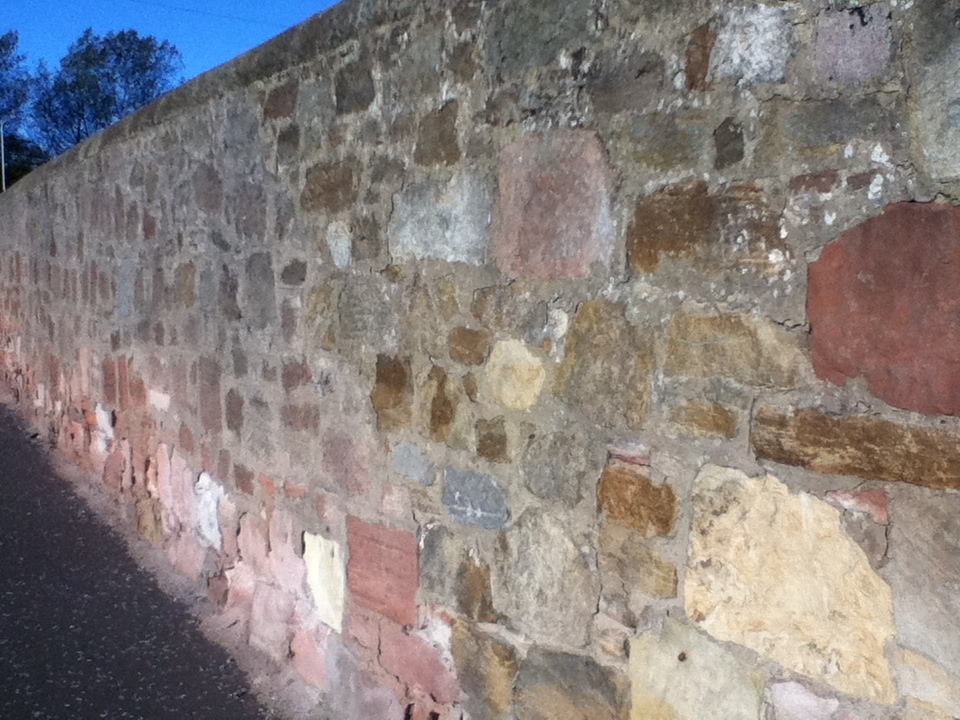

With bike for perspective.
Yes, maintenance is needed soon, or this wall is going down!
___________________________________________

Now that we're on the road, a second obvious difference is that they drive on the left side of the road in Great Britain. Or as they like to say, "the correct side."

I did rent a car one day to drive my Mother-in-law and her friend up to St.Andrews, which is a couple of hours away.  The staying to the left wasn't too bad, but shifting with one's left hand took a little getting used to.  Luckily the shifting pattern is the same. 
What the...?

Key advice from rental car lady - "Stay to the left."

Traffic moving down the left side of the street - taking a left is easy! - taking a right is weird!

The traffic signs all mean something, and if one keeps track of what the next town is and what number road you want to be on, it does work, but vigilance is key each time a round about is approached.  I do not think that I am exaggerating when I say I went through about 150 different round abouts on our 2 hour drive from Edinburgh to St. Andrews.  Nearly every intersection is set up in a round about.


Lots of Information

I can deal with all that, but when they start parking along road sides facing whatever way they happen to be traveling, "they're doing it wrong...:" I start to get confused.

One must be very watchful when riding a bike - cars can be pulling out or opening doors from any old direction. 
Another item that comes with driving is that there is a lot of paint on the road to interpret - bike and bus lanes, turning lanes, speed limits, and other useful information is painted onto the road itself.  Sometime it's confusing - especially when there is construction, which, like any country, there always is.


They also appear to error on the side of too many barriers than too few - not necessarily wrong - but definitely a time consuming aspect of all the construction projects I have seen.The two pictures above with the red and white barriers have to do with the "Tram Project," which involves getting light rail into the downtown area. This could be a posting in itself, as the track shown is actually coming out vs. going in. Many locals are calling it "The Tram Fiasco" - but so it goes in the world of transportation.


On the topic of transportation, there have been many cases we have found where Scotland is "Doing it Right."

Mass transit using buses and trains has been a very positive part of our stay here. It is affordable, enjoyable, and is more sustainable in the long run.


The buses run regularly and on time, are clean and comfortable, and there is plenty of information for riders to know when the next bus is coming and where it is going.  We mostly ride the #3 and the #49. We're starting to have a few 'buddies" who ride the same bus that we do every day. 

People from all walks of life ride the bus here - not just the people who can't afford a car. Similarly, the SoctRail system is a great train system. We have used it for most of our week-end getaways and have found it to be very enjoyable, as again, they are reliable, comfortable, and clean. In addition, as is the case with most rail lines, they take a little different "track" through a country.

Waiting for the 9:50 to Glasgow on Friday - round trip, 11.60 -  ($16.00).  We took the 18:40 on the way back that  Sunday. Military time vs. "am" and "pm" are used.


Train tracks often run alongside the long "lochs" left by the glaciers, as this is where one will find a little flat terrain.
 The scenery and perspective one gains out the window of the trains is fantastic, and a person can buy snacks and drinks on the train, while it is stable enough to write post cards, and it is affordable enough to go most anywhere in Scotland for under $100 bucks U.S. Closer, short trips are usually under $20 bucks. 


If the bus or the train won't do the trick, most cars are tiny little things that get great gas mileage, or you can take one of the diesel engined taxi-cabs. Not many big pickups cruising around over here. The taxi, is built to be a taxi.  Taking a cab is more expensive than the bus, but if one is traveling with a group of people, it can be the way to go.  The drivers have all been very friendly and informative.

Two taxi's and a little Ford "A to B runner."
Next, my favorite form of transportation, the bike, is also well used here. Both the city and the country side have developed their transportation systems to include the bicycle.

Cyclists often were the florescent yellow to be seen in traffic - they are to share the bus lane or sometimes will have their own 3' to 4' foot wide lane depending on the particular road.

There are many places to lock one's bike up throughout the city.

There is an extensive bike trail system that runs throughout the outlying areas of the city that uses what must be old rail-beds that take a very direct path from town to town, usually with very few road crossings.  This trail system keeps the biker off the main roads - usually going under busy roads vs. over them.  It's beautiful riding!
A typical stretch of the trail system in the "suburbs."

____________________________________________________


To get back to the city now, I may as well get another couple of items out of the way: "cheez-o-rama" and "litterbugs."

First, Cheese-o-Rama. Right or wrong, there are many gift shops, all with lots of flags, kilts, postcards and t-shirts.  They all have bagpipe music blaring out of the doors.  This takes away from some of the charm of the old city, but hey, a guys gotta make a buck, right?


One of the big tourist sellers is Scotch Wiskey - how wrong could that ever be?


On the other hand, the city does have a lot of pretty classy stuff going on too. For example, statues of Historical figures and museums.  There are many statues of philosophers from the "Scottish Enlightenment" period.  Below are a few examples of what one will come across while walking the streets.

David Hume - Empiricist and Skeptic
Just down the block is Hume's buddy, Adam Smith, author of the first book of modern economics:
 The Wealth of Nations
Gladstone Monument, an interesting note on this one was that it got moved across town for further development of its previous area in 1953.


Free museums, parks, botanical gardens, and other attractions are great.

Another nice thing about a city that has a long history is that they seem to have been able to nicely incorporate green space along side functional city amenities  Below is one example:


Here we seen the main train terminal pulling into the center of the Edinburgh's main park (Princess Street Park). The close juxtaposition of these two areas make for a great feeling of function and form.

Along with the great green spaces and philosophers who spent so much time trying to figure out the meaning of it all, there are some more mundane challenges for humanity to figure out still.  One of those is litter.  I think that every big city has to work to combat this aesthetic and ecological blight, but I think that because it is always so windy here that is it more apparent than it might otherwise be.  sometimes there is paper blowing around like crazy - until it rains again, then it gets all plastered to the ground.
Litter bugs waiting for the bus.
These are everywhere they should be - they just need to be used more.

There are city and national campaigns and slogans from all sorts of groups trying to help the city look better for its residents and for tourism. I have noticed that some of the blowing wrappers come form the tourists themselves.  Not unusual, but it seems so "fixable" if everyone would just not be a jerk and use the litter bins.

_________________________________________________________


Okay, there may need to be a "Doing it Wrong - Part II" as there is more I would like to share, but you probably have something you really should be getting to.  I must, however, add just a couple more quick shots.

The awesome hand dryer that really works - no wiping hands on pants after.  It's a Dyson design, like the sweet vacuums. These are found in the "paid entry" public toilets.  Yes, for 20 or 30 pence (a quarter) you can enter a clean, warm, not stinky rest room area. There is even an attendant around mopping and making sure there is soap and paper - Doing it Right! - I'll pay the money.


I would also like to mention that the pubs are doing it right too.  As they have been centers of community gatherings for a long time, they are not simply a place to drink. They are also a place to eat, talk, listen to music, and relax.  The older ones are pretty classy too.

Sweet Haymarket Pub


Once inside, the type of beer you choose to drink on-tap, comes in the glass that is meant for that particular beer.  Good marketing, and it helps the bartender remember what you are drinking.


Look tasty?  It is.
Did I mention that all of the sidewalks are done in paver stones vs. poured concrete? Many of the sidewalks downtown are really wide too.  It must be very expensive, but do it right the first time and hopefully we don't have go back and do it again for a long time.  Right/Wrong...?

I'll have to hold it here, but I haven't even gotten to the grocery store yet, which is, of course, where culture really happens. I don't have pictures (yet), but two items I will work on for you are: the check-out people sit in chairs vs. standing, and the carts have full 360 capability - backwards, forwards, sideways - no problem!  Excellent carts. I'll try to get some video of that and get it posted to the WITC - Cultural Exchange site.


Oh yes, there are a number of video clips (some related to blog items, some not) on the WITC Cultural Exchange Progam Facebook page that you can look at by going to:

http://www.facebook.com/photo.php?v=171229482961756#!/video/?id=182653991769844

So there you have some of it.  There are many more of course that could be included, but you get the idea.  I suppose that one could include political and social philosophies, eating habits, child care, health care, and education here too, but those may come within future posts.

If you went through this blog and only looked at the pictures (Ryan!) -

 "You're doing it Wrooonng!" : )

Saturday, October 8, 2011

Historical Connections on a Scottish Bike Ride

As it was a nice day, 55 degrees, windy and mostly sunny, and all of my email was caught up, so I decided to go for a bike ride to a place not far from the Dalkeith house called "Queen Mary's Mount." This seems like a straight forward endeavor, but because Scottish history is such that one cannot touch one aspect of it without sending implication shock waves reverberating through time, it is not.


I'll try to explain how it is that even an innocent ride to a hill in the next woods over can bring the long history of this nation out into the open once again, and because it is everywhere, it is not always trumpeted the way our country, with it's shorter European history, often does.


Passing over one of the old bridges over the south fork of the River Esk, which is making its way to the sea via Musselburgh, I make my way off "The Estate," past some fields, and the hill called St.Mary's Mount can easily be seen in the distance.  It's only a few miles away.

The river Esk

St. Mary's Mount in the distance
After passing by a meadow or two with cattle grazing, the trail begins to lead up the hill.


Your standard perfect, massive oak in a meadow 


Past the meadow and into the woods


Trail leading up.


It's steeper than it looks from a distance, so giving up the pedals and just walking the bike in spots is the way to go for this old guy.  As I climbed I thought about what I knew about this place.  It is the place where Mary Queen of Scots gave herself up to the English Army - without a fight, even though she did have armed men at her disposal.

You see, Mary was in trouble because of her religion and her marriages, and because of where she was born and religious uprisings and her relationship to Queen Elizabeth...

Oh I can't keep it all strait! Cue the Web page! http://www.marie-stuart.co.uk/

Mary Stuart was born at Linlithgow Palace on 7th December 1542, the daughter of James V of Scotland and Mary of Guise. Six days after her birth her father died, and she became Queen of Scotland. From her infancy, Scotland's rival pro-English and pro-French factions plotted to gain control of Mary. Her French mother was chosen as regent, and she sent Mary to France in 1548.  Mary lived as part of the French royal family.

In April 1558 she married the Dauphin Francis; she secretly agreed to bequeath Scotland to France if she should die without a son. In July 1559 Francis succeeded his father becoming King Francis II and Mary became Queen of France as well as of Scotland.  In addition, many Roman Catholics recognised Mary Stuart as Queen of England after Mary I died and the Protestant Elizabeth I succeeded her to the throne in November 1558. Mary Stuart's claim to the English throne was based on the fact that she was the grand-daughter of Margaret Tudor, sister of Henry VIII--Elizabeth's father.

To the Roman Catholics, Mary's claim appeared stronger than Elizabeth's because they viewed Henry's marriage to Anne Boleyn as illegal.  Mary's young husband Francis II died in December 1560 after a reign of 17 months. Mary, who was about to become 18 years of age, was left in a difficult position. Unwilling to stay in France and live under the domination of her mother-in-law Catherine De Medicis she decided to return to Scotland and take her chances with the Protestant reformers.

Yes, take her chances in Scotland.  She wasn't in a pickle yet, but there is history of trouble on this same hill that she would eventually give herself up on, you see.


That trouble on this hill being the Battle of Pinkie, cue another website: http://www.battlefieldstrust.com/resource-centre/medieval/battleview.asp?BattleFieldId=68

Attempts by the English to link the two kingdoms, of England and Scotland, through the marriage of the young queen Mary of Scotland and prince Edward (later Edward VI) of England, collapsed into open conflict in 1544-5. This was halted by the treaty of 1546, but the Duke of Somerset, now effectively ruling England during the minority of Edward VI, simply used the cessation to prepare for war. This time he planned a major land campaign to secure territory, not simply a major raid for these had always previously failed to achieve any long term success for either side.

The army was mustered at Berwick and from there, in early September, it crossed the border, marching north on the main east coast route, supported and supplied by the English fleet. In response the Earl of Arran mustered northern Scottish forces. Once aware of the English route, Arran marched to block their approach at the crossing of the Esk near the coast at Musselburgh.

On the 9th of September, 1547 the English approached from the east and camped at Prestonpans.The next day, at Carberry, on what is now known as Bothwell field, saw the last great battle between the two kingdoms before they became united under the rule of a single monarch in 1707, and it proved a dramatic Scottish defeat.


A dramatic defeat indeed.  The Scottish loss of life was in the thousands; estimates vary from 6,000 to 15,000, while the English losses are estimated at 500 to 600.  Below is a picture, taken about 1/2 way up the hill that overlooks the site of the battle, Bothwell field.

View toward Edinburgh from St. Mary's Mount - scene of the Battle of Pinkie
Notice that the year of this battle was 20 years before Mary would eventually surrender to the English on this same hill.  Back to Mary's story then:

On 19th August 1561, Mary landed at Leith and immediately took the advice of the moderates James Stuart (her half-brother, later earl of Moray) and William Maitland of Lethington. She recognised the Reformed (Presbyterian) church and allowed it a modest endowment but not full establishment.

The Protestant reformers, including John Knox, were horrified because she had Mass in her own chapel, and the Roman Catholics were worried about her lack of zeal for their cause. For the next few years Mary tried to placate the Protestants and befriend Elizabeth while at the same time negotiating a Catholic marriage with Don Carlos, the son of Philip II of Spain. When refusals came on both the English succession and the Spanish marriage Mary accepted a marriage of love rather than a purely political match. She married her first cousin Henry Stewart, Lord Darnley on 29th July 1565.

Scotland: The Final Years

This marriage was unacceptable to the Protestants, and Moray, with the aid of other nobles, raised a rebellion which Mary quickly suppressed. Nevertheless she felt betrayed by her Protestant advisors and withdrew some of her support from the Reformed church. Her marriage with Darnley soured and she refused him the right to succeed if she died without issue. Alone and disappointed, Mary turned to her Italian secretary, David Rizzio, for comfort and advice. The Protestant lords disliked Rizzio's influence because they suspected him of being a papal agent, and Darnley openly stated that the Italian was too intimate with the Queen.

On 9th March 1566 a group of Protestant lords, acting with the support of Darnley, murdered Rizzio in Mary's presence at Holyrood Palace. Mary, who was six months pregnant, survived the horrible ordeal. In Edinburgh Castle on 19th June 1566, estranged from her husband and his allies, she gave birth to a son James (later James I of England).  By the end of 1566 Mary had befriended James Hepburn, Earl of Bothwell, and was seeking a way to dissolve her marriage with Darnley. Various schemes were concocted; it seems unlikely, however, that Mary was aware of the actual plot to eliminate her husband.

On 10th February 1567 Darnley was murdered at Kirk o' Field; the circumstances of his death to this day remain a mystery. At the time, Bothwell was believed to be the chief instigator. Nevertheless he was acquitted after an all too brief trial. In April, Mary went off with Bothwell (perhaps a victim of abduction); early in May he obtained a divorce from his wife, and on 15th May 1567 he and Mary were wed according to the Protestant rite.  These events alienated even some of Mary's closest supporters. The nobles, many of whom disliked Bothwell, banded together to face Mary and her new husband at Carberry. The Queen was forced to surrender, and Bothwell fled. 

To end the story, Mary was brought to England where she was imprisoned for 19 years, then got her head chopped off. (Sorry, there is much more to this story, but it doesn't take place here.)

I continued to make my way to the top of the hill. Coming through thick woods and grass one comes upon the monument beside a large tree and crumbling stone wall.

That's it. 


From the monument site, I could also hear a road just a few 100 yards away.  This road is where a person could drive to, to get to the monument. However, there is no parking lot, and as you will see, not much of a sign, so one would need to really know about the monument beforehand in order to find it in the first place.


The history here in Scotland is not always prevalently displayed, but it is always around. 

Now, stick with me a little longer as I head back down the hill toward home, via a different trail through the woods, as the stories connected with this hill continue.


First, a small stone monument, of the same date as the Queen Mary one, 1887, that suggests that trenches that are prevalent in this stretch of woods just below the hilltop were dug out by soldiers during the Battle of Pinkie and were used in the lead up to Queen Mary's surrender.


Remnants of a Trench


Just a bit further down the trail, there is a more modern sign, correcting, or at least refuting the claim made by the old stone marker, suggesting that the entrenchments were not "thrown up" by Soldiers, but rather, that they are left over from an Iron Age people who had created them to protect a settlement that was here over 2,000 years ago.
Artist's rendition of Iron Age Settlement
Another aspect I was reminded of as I made my way down the muddy track back to the fields, was that the Carberry estate was once a great arboretum.  When the Beccleuch Estate bought the property, they harvested much of the old woods that was planted in the 1700's. The buyers did this, much as we often do in Wisconsin, to help pay for the property.

4 foot diameter at the base - Oak.
The above Giant Sequoias were planted it the 1700's along a path that used to lead to the Carberry Palace itself. This is no longer the main entrance to the place, but it makes for a great bike ride, as I get toward the bottom of the hill again.


What is that across the meadow? Yes, it's the Carberry palace itself.  Enter another story.
Storybook View of Carberry Palace
Closer view of Carberry with a portion of St. Mary's Mount behind.
Current entrance to Carberry - only since the late 1800's - baby trees.


I will not add the story about this place on this already history heavy post, but I will add that the story leads us to Afganistan and the infamous "Retreat From Kabuhl" as the castle was transformed into a palace by Governor General Lord Ellenburgh.  Follow the link to learn more about a war and battles that first lead to the phrase "graveyard of empires" to be used when speaking about Afghanistan.

http://www.britishbattles.com/first-afghan-war/kabul-1842.htm

It seems an extraordinary place, this Queen Mary's Mount, and it is in many ways, but there are so many places like this that it is difficult to pay attention to them all.  However, what one can pay attention too is the constant connection to history that one finds throughout Scotland.  Over time, the battles, religions, royalty, and lands begin to make a picture of a country whose people have endured it all, and in my opinion, kept a pretty good attitude.


As I was leaving out the front gate of Carberry, a young fellow was working on the massive wooden and steel gate that fronts the drive.  I asked if it was okay for me to use the entrance the next time I came out this way.  He said, "Aye, there's no trespassing laws in Scotland."  That's right, it's the Right to Roam Act.  Cue another web site!

http://www.ramblers.org.uk/freedom/righttoroam/countryside_access